

Long-Term Infrastructure Operations and Maintenance – Guide for Developers
Infrastructure projects unfold in two major phases. First is the development and construction period. Then, decades of infrastructure operations and maintenance follow, when the asset either meets or misses its service obligations. The second phase ultimately determines whether the project fulfils its purpose.
A World Bank study found that the direct cost of service failures in low- and middle-income countries amounts to $195 billion per year, encompassing power outages, transport disruptions, and water supply interruptions while excluding indirect coping costs, loss of competitiveness, and the capacity to attract investment(World Bank, 2021). These failures often arise from decisions made during development, in design, procurement, or performance specification, before any service contractors mobilise on-site.
Building on this context, this article examines long-term infrastructure operation and maintenance considerations that influence asset performance and explains why the development phase is essential to project success.
Defining Infrastructure O&M

Infrastructure operations and maintenance (O&M) include all activities needed to keep an infrastructure asset at its intended service level after construction. “Operations” covers daily running: staffing, energy management, monitoring, and service delivery. “Maintenance” covers physical interventions to preserve or restore asset condition and performance.
Consequently, over a concession life of 20 to 30 years, the operational phase must deliver the required service, keep the asset available, and manage costs and standards sustainably.
These obligations include different maintenance categories:
- Routine maintenance covers daily inspections, cleaning, and minor adjustments.
- Planned preventative maintenance involves scheduled component replacements and overhauls designed to prevent failures before they occur.
- Corrective (reactive) maintenance addresses unplanned failures and breakdowns requiring quick action.
- Major lifecycle renewals are capital-intensive and restore or extend an asset’s life. Examples include replacing a turbine rotor, resurfacing a highway, or overhauling metro system bogies.
Balancing these categories is vital as a strong preventive regime reduces corrective maintenance and emergency interventions, lowering costs and disruptions.
Why Operation and Maintenance Starts During Design
An asset that is difficult or expensive to maintain by design will remain so regardless of the operator. Therefore, the development team should review designs operationally before finalisation. This includes formal maintainability reviews, challenging design assumptions based on lifecycle costs, and ensuring O&M input in the technical brief from pre-feasibility.
Key considerations for maintainability include material specifications and durability, component standardisation, and physical accessibility for inspection. Redundancy in critical systems and the availability of condition monitoring are also important. For example, a power plant designed without crane access forces operators to use expensive temporary works for major replacement.
World Bank Group’s PPP Reference Guide from 2017 references the full integration of design, construction, operation, maintenance, and refurbishment as a method to reduce total costs, whereas design-build contracts that exclude maintenance and operation may lead to suboptimal design choices and higher downstream maintenance and operating costs (World Bank Group, 2017).
The American Public Transportation Association’s standard on new rail transit projects requires the involvement of experienced rail operations personnel throughout all phases of project development, from planning through construction to commissioning (APTA, 2017). The standard reflects hard-won experience: design and construction decisions made without operational input often lead to maintenance complications that persist throughout the asset’s life.
Performance Targets: Defining What Success Looks Like
Key performance indicators (KPIs) translate service requirements into measurable obligations. They allow to hold operators accountable and assure lenders that the asset will generate revenue and maintain the required service level over the debt tenor.
The Global Infrastructure Hub’s review of 250 PPP projects found that KPI-related disputes are 20% of all PPP disputes (Global Infrastructure Hub, 2018). The sources of these disputes are revealing. Poorly defined KPIs that rely on subjective judgment lead to recurring disagreements. On the other hand, over-specified KPIs with small deduction values make monitoring uneconomic. When the deduction values are lower than the cost of fixing failures, the operator may accept the penalty rather than fix the problem.
A subtler risk is the gap between short-term KPI compliance and long-term asset health. KPIs measuring service output-availability, response times, and user satisfaction do not indicate whether preventive maintenance is performed. Operators may meet every output KPI for years while deferring needed overhauls and inspections. When performance drops, rectification costs far exceed what earlier intervention would have required. The World Bank’s 1994 World Development Report found that in Africa, $12 billion in timely maintenance could have averted $45 billion in road reconstruction (World Bank, 1994). Defining the KPIs right is therefore an important and challenging exercise.
The EBRD’s PPP guidelines recommend that performance mechanisms are simple to administer, linked to measurable deliverables, and supported by dispute-resolution and accountability mechanisms (EBRD, 2024). Good practice separates output-based KPIs (measuring service quality as experienced by users) from input-based KPIs (measuring maintenance activity). Also, penalty regimes should treat repeated minor breaches as increasingly serious.
Deductions must always make fixing an issue more economical than non-compliance. Otherwise, the contract may incentivise the wrong behaviour.
Selecting an O&M Contractor for Long-Term Performance
Once the asset’s design and performance framework are established, the next critical development-phase decision is selecting the O&M contractor responsible for maintaining the asset and delivering its service requirements over the concession.
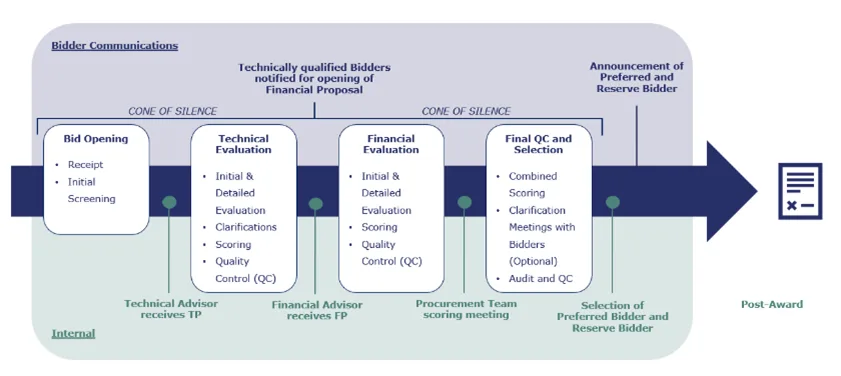
Considerations go beyond price for the selection process. For long-term performance, developers should evaluate the contractor’s track record with similar assets, technical capabilities, ability to retain skilled personnel, maintenance management, approach to preventive versus reactive maintenance, mobilisation plan at EPC handover, and the interface between O&M and EPC warranty provisions.
BCG’s analysis found that operating costs account for 80% to 90% of train lifecycle costs (Boston Consulting Group, 2023). This means choosing an O&M contractor solely on the basis of the lowest fee, without assessing their capacity for sustained performance, is a false economy. Contractors without technical depth or preventive maintenance systems incur higher corrective costs, more downtime, and faster asset degradation, harming project economics and service quality.
Warranties and asset reliability initially mask operational shortcomings. Once warranties end and assets age, contractor weaknesses become more evident: slower fault response, deferred maintenance, and more emergency fixes.
Of course, construction quality matters too. Defects after commissioning and the defects liability period become the O&M contractor’s and asset owner’s problem.
O&M Contract Terms
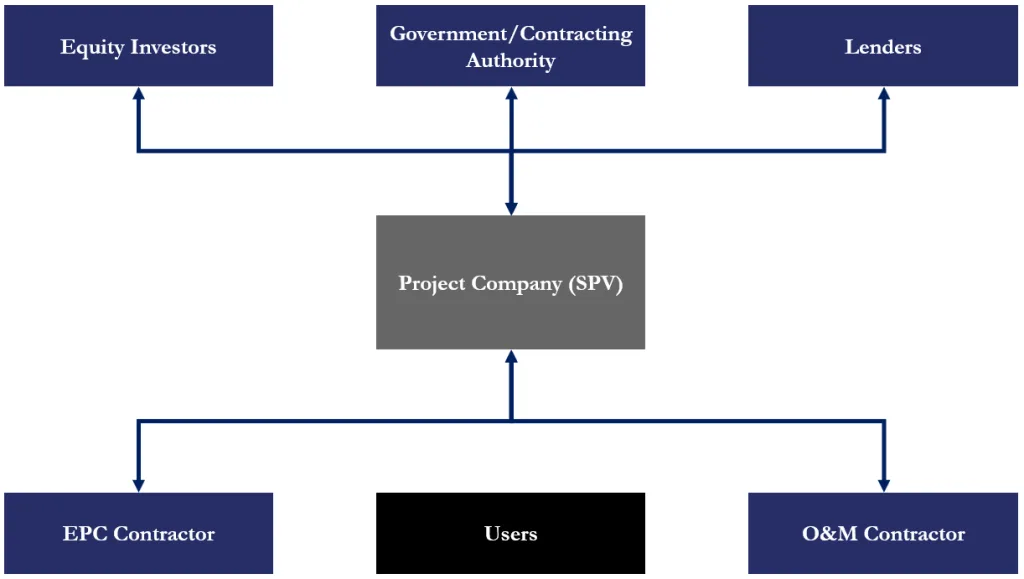
In a project finance structure (where borrowing is secured by the project’s future revenues), the O&M contract is between the special purpose vehicle (SPV) or project company and the O&M contractor. The SPV holds the concession, secures financing, and contracts separately with both the EPC and O&M contractors. Thus, the O&M contract must protect the SPV’s ability to meet its obligations to both the procuring authority and lenders. Several contract terms are especially important.
Scope, performance standards, and payment
The O&M contract must clearly define the contractor’s scope of services, performance standards, and payment mechanism. If payment links to KPIs, the deduction regime in the concession agreement must be consistently reflected in the O&M contract so that the SPV does not absorb the contractor’s performance risk.
Interface with EPC warranties and defects liability
During the early operational years, the EPC contractor’s defects liability obligations overlap with the O&M contractor’s maintenance responsibilities. Ambiguity in this boundary is a frequent source of disputes: is a recurring fault an EPC defect or an O&M maintenance issue? The O&M contract must clearly allocate responsibility for identifying, reporting, and rectifying defects during the liability period, and define how the O&M contractor cooperates with the EPC contractor to resolve them. Without this clarity, the SPV risks being caught in the middle between two contractors, each pointing the finger at the other.
Performance security
The SPV needs assurance that the O&M contractor will fulfil its obligations over the contract term. This typically takes the form of a performance bond or bank guarantee, sized to cover the cost the SPV would incur if it needed to replace the contractor.
Termination, replacement, and transition
The O&M contract must give the SPV the right to terminate the contractor for persistent underperformance or material breach, and to appoint a replacement. This right must be practically exercisable: the contract should define the process for transition to a successor operator, including cooperation obligations, data and documentation transfer, continued service delivery during the handover period, and restrictions on the outgoing contractor withdrawing key personnel before the successor is mobilised. These transition provisions apply at any point during the concession, whether at natural contract expiry, early termination, or at the concession end, when the asset may revert to the public sector.
Reporting and monitoring
The O&M contractor’s reporting obligations must provide the SPV (and, through the SPV, the procuring authority) with adequate visibility into asset condition, maintenance activities, and performance trends. This includes periodic maintenance reports, asset condition surveys, incident reporting, and access to maintenance management system data. Without robust reporting, the SPV has no basis for verifying that preventative maintenance is being performed, lifecycle obligations are being met, or early signs of asset degradation are being addressed.
Commissioning and Handover: Bridging Construction & O&M
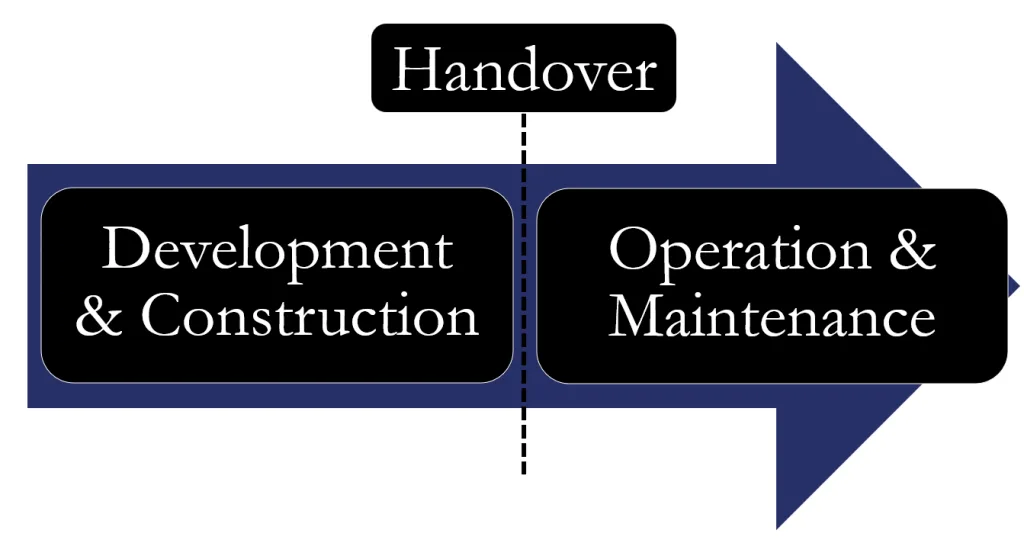
Handover must be planned during development as a structured process rather than treated as a single contractual event.
Commissioning and performance testing must verify that systems perform as designed under realistic operating conditions, in accordance with the acceptance criteria defined in the procurement documents. The defects liability period provides a contractual window for identifying and rectifying construction defects, but its effectiveness depends on the rigour of the inspection regime and the clarity of defect classification standards.
As-built documentation (including detailed equipment inventories, maintenance manuals, and system configuration records) forms the operational baseline for the O&M contractor. Incomplete or inaccurate documentation forces the operator to reconstruct this knowledge at their own cost. Additionally, training and knowledge transfer from the EPC contractor to the operations team must be contractually mandated and independently verified, particularly for complex systems.
Infrastructure O&M Diligence: A Development-Phase Checklist
O&M priorities vary by sector. The checklist below is intended as a cross-sector framework. Developers should adapt the emphasis to match the specific asset class and operating environment.
| Area | Key Questions |
| Design | Are maintenance access arrangements adequate for all major components? Are components standardised to reduce maintenance complexity? Is redundancy built into critical systems? Has a maintainability review been conducted before design freeze? |
| Lifecycle planning | Has a lifecycle cost model been developed covering all maintenance categories? Are major renewal intervals and costs identified and financially provisioned? Does the maintenance philosophy balance preventative and corrective strategies appropriately? |
| KPIs (often found in Performance Schedules) | Are KPIs objectively measurable and dispute-resilient? Are deduction values calibrated so rectification is preferable to non-compliance? Do KPIs capture long-term asset health as well as short-term service delivery? Is the monitoring regime proportionate and cost-effective? |
| O&M contractor selection | What is the contractor’s track record on comparable assets? Does the staffing plan demonstrate adequate technical depth? What maintenance management systems will be deployed? Is the mobilisation plan credible and aligned with EPC handover? How is the interface between EPC defects liability and O&M obligations managed? |
| Infrastructure O&M Contract Terms | Is the scope of services clearly defined and consistent with the concession obligations? Is the EPC/O&M interface during defects liability cleanly allocated? Are lifecycle reserve accounts funded from the outset? Are termination, replacement, and transition-out provisions practically exercisable? Are reporting obligations sufficient to give the SPV visibility into asset condition? |
| Handover | Are commissioning acceptance criteria defined in procurement documents? Is the defects liability regime rigorous and clearly classified? Is as-built documentation contractually mandated and independently verified? Are training and knowledge transfer requirements specified? |
What This Means for Key Stakeholders
For developers:
O&M diligence belongs in the development budget, not as an afterthought once construction is underway. The expenditure on maintainability reviews, lifecycle cost modelling, and rigorous O&M contractor due diligence pays for itself many times over during the operational decades that follow. Projects that treat O&M planning as a downstream activity, secondary to achieving financial close and completing construction, risk higher lifecycle costs, weaker bankability, and greater operational risk.
For lenders:
O&M structure is a core credit issue. The existence of an O&M contract matters less than the substance of what underpins it: whether KPIs are enforceable and correctly calibrated, whether the O&M contractor has the capacity to support the asset over the debt tenor, whether lifecycle obligations are funded, and whether the contract structure can absorb the stresses of a 25-year concession.
For procuring authorities:
The quality of the performance framework they require at the procurement stage directly shapes the service they will receive for the next 20 to 30 years. Output specifications that are too vague leave performance open to interpretation, while overly lenient KPIs erode accountability. Procuring authorities must also retain independent access to asset condition data needed to monitor performance throughout the concession period.
For O&M contractors:
The development phase sets their commercial terms. Contractors who engage early by offering operational insights in design reviews, shaping realistic KPI frameworks, and negotiating clear EPC interfaces position themselves to deliver sustainably over the contract. Those inheriting poorly designed assets and underfunded lifecycle plans face structural difficulties from day one.
Conclusion
Long-term operational success depends on several conditions working together: maintainability embedded in design, the right O&M contractor in place, KPIs that drive the correct behaviour, contract terms that protect the SPV across the full concession, and a commissioning process that correctly bridges construction and operations. Weaknesses in any one area cannot be fully offset by strength in another.
The development phase is where each of these conditions is established and where the cost of getting them right is a fraction of the cost of correcting them later.
Talk to our team
For guidance on structuring infrastructure projects for long-term operational success, contact our team at info@gi-advisors.com.
Stay ahead of the curve
Follow us on LinkedIn to receive regular updates on how to successfully develop large-scale infrastructure.
References
- American Public Transportation Association. (2017). Operations personnel requirements in new rail transit projects
- Boston Consulting Group. (2023). Total cost of ownership puts rail procurement on the right track. https://www.bcg.com/publications/2023/total-cost-of-ownership-puts-rail-procurement-on-right-track
- European Bank for Reconstruction and Development. (2024). PPP regulatory guidelines collection, Volume II: Recommendations on PPP payment mechanisms.
- FIDIC. (2008). Conditions of contract for design, build and operate projects (Gold Book, 1st ed.).
- Global Infrastructure Hub & Turner & Townsend. (2018). Managing PPP contracts after financial close.
- World Bank. (1994). World development report 1994: Infrastructure for development. Oxford University Press.
- World Bank (2017). PPP Reference Guide Version 3
- World Bank. (2021). Well maintained: Economic benefits from more reliable and resilient infrastructure.


